
The message that reached Madison on the morning of October 10, 1871, did not come straight down a wire.
Marinette lumberman Isaac Stephenson had to send a man to Green Bay, the nearest town with a working telegraph line, because the fire had taken everything closer.
Governor Lucius Fairchild was not there to read it. He was in Chicago with relief supplies for a different fire, one that had started the same Sunday night and would take the national headlines.
The Wisconsin fire killed far more people, yet for decades the only major publication about it was a pamphlet by a Green Bay journalist.
Two Fires, One Sunday Night
Both fires began on the evening of Sunday, October 8, 1871, roughly 200 miles apart. (The anniversary fell on a Thursday this year, which seems to be how a few recent retellings moved the fire there. The 1871 calendar is not ambiguous.)
| Detail | Great Chicago Fire | Peshtigo fire |
|---|---|---|
| Began | Evening of October 8, 1871 | Evening of October 8, 1871 |
| Deaths | About 300 | Estimated 1,200 to 2,400 |
| Area burned | Over 3 square miles | About 1.5 million acres |
| Buildings | More than 17,000 destroyed | Two left standing in Peshtigo |
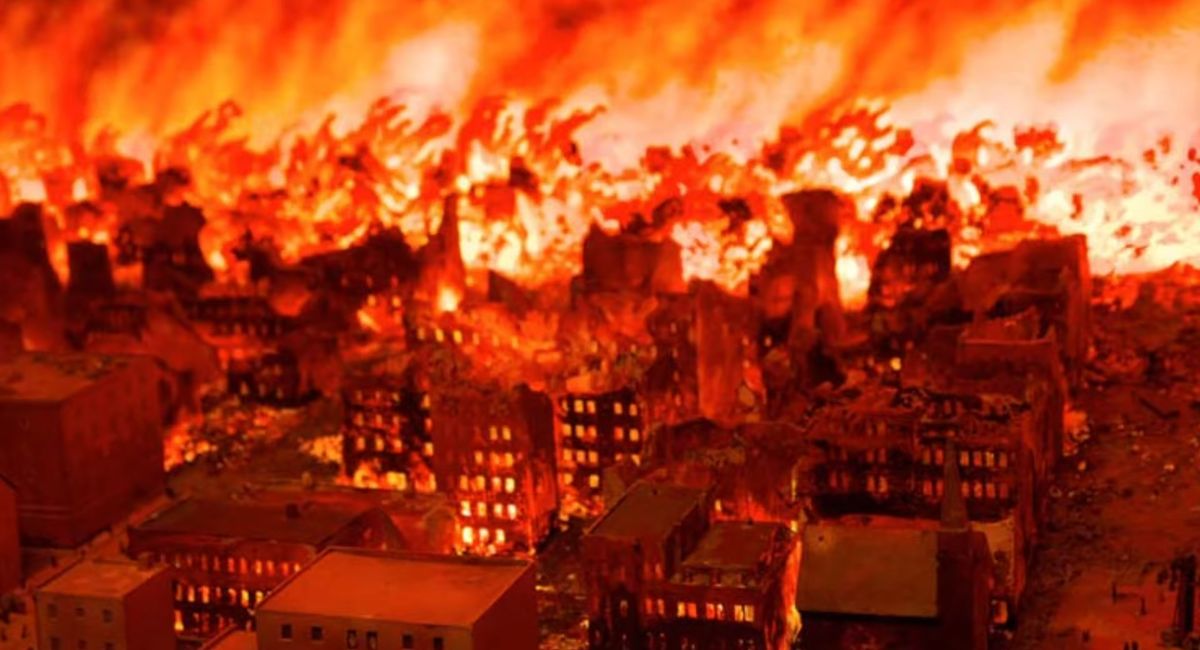
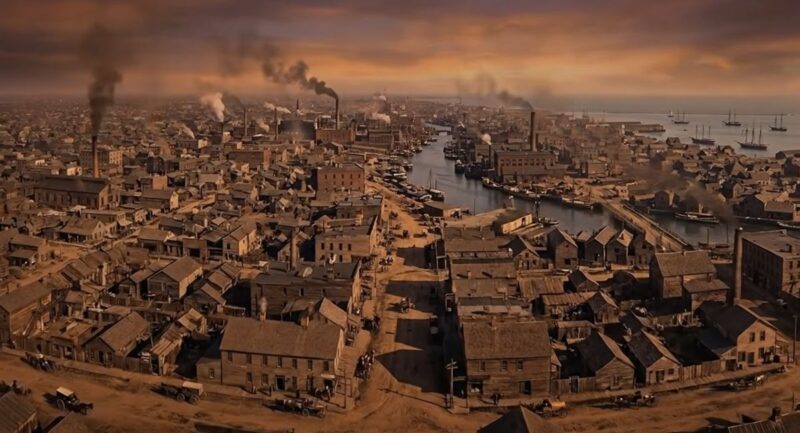
While the Peshtigo Fire claimed far more lives, the Great Chicago Fire became one of the most widely remembered disasters in American history. The AI-generated reconstruction below illustrates how flames spread through Chicago in October 1871, offering a visual perspective on the catastrophe that overshadowed the deadlier Wisconsin wildfire.
Most figures above come from the National Weather Service account of the Great Midwest Wildfires of 1871.
By the low estimate, the Wisconsin fire killed four times as many people as Chicago did. At the high end, eight times.
The Peshtigo Fire remains the deadliest wildfire in American history, yet it received far less attention than the Great Chicago Fire that began the same night. The video below explores how the disaster unfolded, the conditions that fueled its rapid spread, and why one of the country’s worst tragedies faded from national memory.
Why the Woods Were Ready to Burn
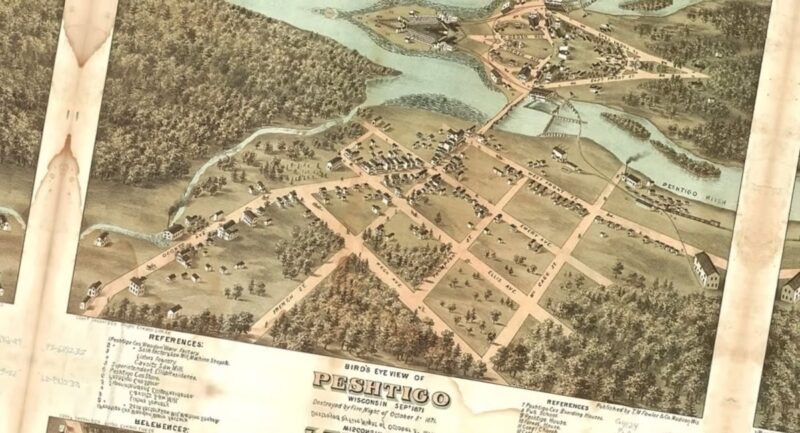
Peshtigo was a mill town of about 1,700 people, built on a sawmill and a woodenware factory.
Both belonged to William B. Ogden, a former mayor of Chicago, who lost property to both fires within the same day.
Several ordinary conditions stacked up at once that autumn.
- Rain had been scarce for months, and by October many streams and wells had gone dry.
- Settlers and railroad crews cleared land by burning brush, and those small fires smoldered for weeks in bogs and old burns.
- Smoke hung so thick over the bay that foghorns sounded and ships steered by compass.
- A strong low pressure system over the central Plains drove southwesterly winds across the region on October 8.
Historians later judged the drought severe but not extreme. What turned it lethal was the fuel and a weather change arriving on a night when hundreds of fires were already lit.
What the Weather Records Actually Show
Many retellings give 110 mph winds and 2,000°F flames. Those are estimates from a 2002 history, not measurements taken that night.
The Army Signal Service, which kept weather records at the time, logged inland Wisconsin winds of no more than 14 mph at 9 p.m. In a 2004 Forest Service review of fire behavior at Peshtigo, editor Hutch Brown reads that gap plainly. Survivors felt a hot gale because the fire was making its own wind.
A firestorm is a violent convection event fed by a large, continuous area of intense fire. Its rising column of hot air pulls wind in from every side, and the colliding drafts can spin into fire whirls that carry burning debris up to 3 miles ahead of the flames.
Witnesses who described a tornado were likely describing exactly that. Survivors reported treetops twisted off and burning debris lifted into columns of flame.
The River, the Boardinghouse and the Sugar Bushes
Then the fire reached town.
Father Peter Pernin, a French-born priest who served Peshtigo and Marinette, joined the crowd in the Peshtigo River and stayed in the water most of the night. His eyewitness account, published in 1874, gave the line historians still quote, that “the air was fire.” He wrote that he came out of the river at about half past three in the morning.
The river saved many people, but not all. According to the Wisconsin Historical Society, 75 people who stayed inside a boardinghouse died there, and only two buildings in Peshtigo survived.
The worst losses came in the Sugar Bushes, farm settlements outside town with no river to run to. Investigators identified 241 bodies there.
One hundred twenty-three of them were children.
How Many People Died
Nobody knows the exact number, and the counts disagree because each one measured something different.
| Count | Who made it | Figure |
|---|---|---|
| Dead identified by name | Col. J. H. Leavenworth, printed in the 1873 Assembly Journal | 383 |
| Deaths in the town of Peshtigo | Wisconsin Historical Society | 500 to 800 |
| Known and believed dead | Wisconsin Historical Society | 1,152 known, 350 more believed |
| Overall estimate | National Weather Service | 1,200 to 2,400 |
Whole farmsteads, boardinghouse lodgers and logging camp crews left no trace, so a name count could only ever be a floor.
The Forest Service review adds that many of the dead were new settlers and itinerant workers, the people least likely to appear in any town record.
The Acreage Problem
Even the burned area is disputed. The Wisconsin Historical Society describes a swath 10 miles wide and 40 miles long destroyed in about two hours, with a total above 280,000 acres.
By contrast, the Weather Service gives about 1.5 million acres, and the Forest Service review puts Wisconsin at 1.28 million.
Here is my own arithmetic. A strip 10 by 40 miles covers 400 square miles, and at 640 acres per square mile that comes to 256,000 acres.
The smaller figure sits suspiciously close to that one swath, which suggests it may describe the core burn rather than the whole region, though the society does not say how it was reached.
Did you know? Wisconsin was not the only state burning that night.
Holland, Manistee and Port Huron in Michigan all suffered serious damage, and the Weather Service estimates Michigan deaths at likely more than 500.
Why Chicago Got the Headlines
Chicago had newspapers, telegraph offices and a national audience. News from Peshtigo had to travel by messenger to Green Bay before it could go anywhere at all.
Next to my running list of “firsts” that turned out to be seconds, I keep a shorter one of disasters that lost the front page to a neighbor, and Peshtigo sits at the top of it.
Relief still came, and much of the first wave depended on one person in Madison. With the governor away, the telegram landed with his family.
- Frances Fairchild, wife of the governor and not yet 24, took charge in Madison and redirected a boxcar of supplies.
- Finding no winter goods aboard, she rallied Madison women to add blankets, and a second boxcar left that same night after her public appeal.
- Later relief included $166,789 in cash donations and federal shipments of 4,000 wool blankets and 200,000 rations.
The Comet That Did Not Do It
In 1883, Minnesota writer Ignatius Donnelly suggested that fragments of Biela’s Comet, which had broken apart decades earlier, set Chicago, Peshtigo and Michigan alight together.
A 2004 paper by engineer Robert M. Wood revived the idea. (Donnelly had published a book on Atlantis the year before, which is worth knowing before weighing his astronomy.)
The theory has a timing appeal and very little else. Comet debris does reach Earth on schedule, as with the Halley dust that arrives every October, but it burns up high in the atmosphere. No credible record shows a meteorite starting a fire on the ground.
The blue flames some survivors described fit burning carbon monoxide far better than comet gas. Nor did the fire need help from space. It had hundreds of brush fires already burning in the woods.
Still the Deadliest on Record
More than 150 years later, no American wildfire has come close. The 2023 Lahaina fire on Maui, the deadliest in the country for over a century, reached a toll of 102 deaths by June 2024. Even the lowest Peshtigo estimate is nearly 12 times that.
The ranking itself is solid. What remains uncertain is the size of the gap, because the high and low Peshtigo estimates differ by about 1,200 people, more than 11 times the full Lahaina toll.
My own view is that Peshtigo was never really forgotten in Wisconsin. It was simply never fully counted, and a disaster without a firm number has trouble holding a place in national memory. Chicago, by contrast, could count its losses building by building.
The Names Nobody Wrote Down
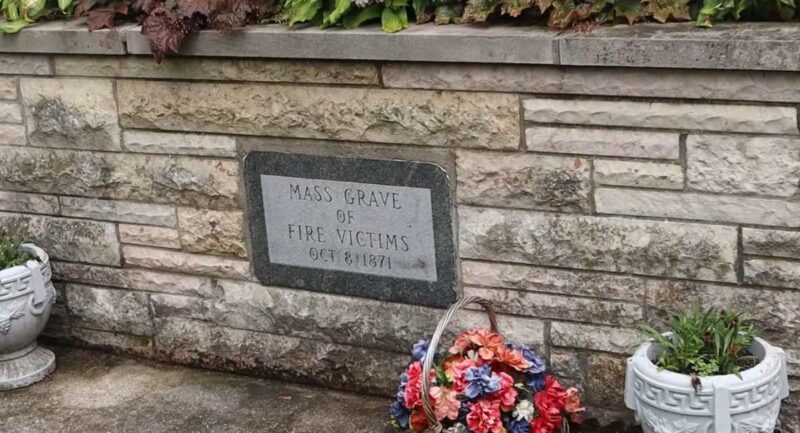
Leavenworth finished his list with 383 names.
Current estimates put the dead at three to six times that many, and the difference is made up of lumber workers, new settlers and families whose farmsteads vanished without a trace.
Local records burned along with the town. If anyone ever made a full list of who lived in the Sugar Bushes in October 1871, it has not survived.
What does survive is the slow route the news took, from a burned mill town to a telegraph office in Green Bay to a governor who was in Chicago helping somebody else.