
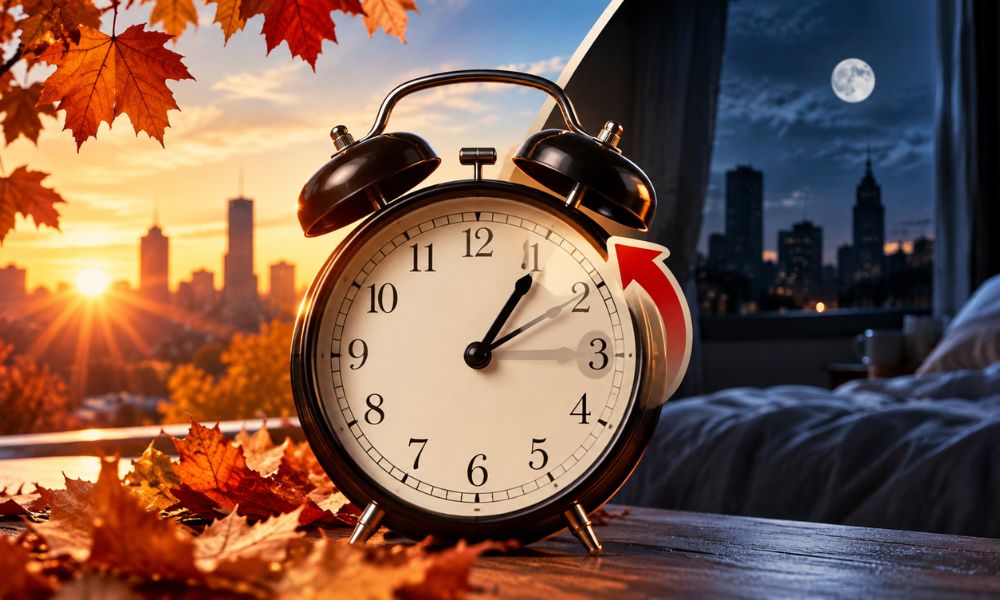
On Sunday, November 1, at 2 a.m., most clocks in the United States fall back to 1 a.m., and the country returns to standard time.
Of the two yearly switches, the fall one is the change sleep doctors like. What they want is for the clocks to stay put afterward.
Congress is leaning the other way. In July, the House passed a bill to make daylight saving time permanent, and the American Academy of Sleep Medicine spent early October arguing against it.
I have read the bills, the position statements and the studies behind them. The evidence is stronger on some points than either side admits.
What Changes at 2 a.m. on November 1
At 2 a.m. local time, clocks move back to 1 a.m. sunrise and sunset jump an hour earlier on the clock overnight.
In Portland, Maine, by my calculation, sunset moves from about 5:35 p.m. on October 31 to about 4:33 p.m. on November 1.
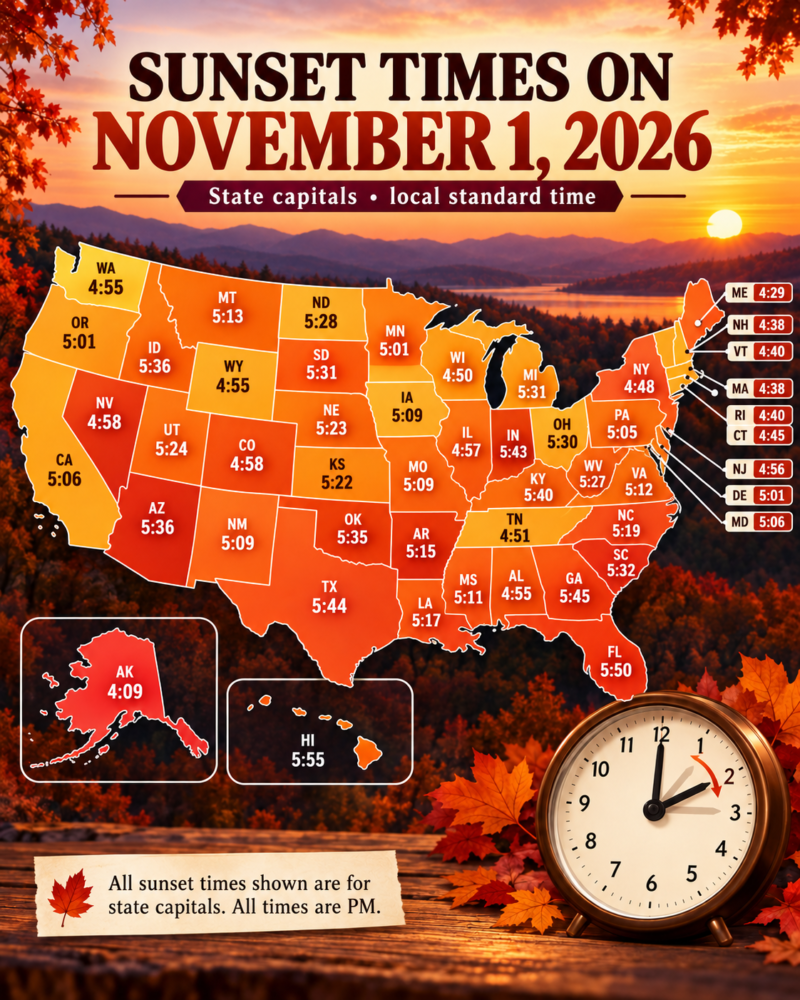
Federal law lets states opt out of daylight saving time, and the U.S. Department of Transportation lists the places that skip it.
- Hawaii.
- Most of Arizona, although the Navajo Nation in the northeast of the state does observe daylight saving time.
- American Samoa, Guam, the Northern Mariana Islands, Puerto Rico and the U.S. Virgin Islands.
A state can choose year-round standard time on its own. Year-round daylight time needs Congress.
The Hunter’s Moon on October 26 will be the last full moon of 2026 to rise on daylight time.
The House Voted for the Opposite of What Sleep Doctors Want
On July 14, 2026, the House passed H.R. 139, the Sunshine Protection Act, by a vote of 308 to 117. The bill would make daylight saving time permanent nationwide. A state could stay on standard time only if its own legislature passed an opt-out law.
The Sunshine Protection Act has brought the debate over changing clocks back to Capitol Hill.
In this ABC News video, a reporter explains what the proposed legislation would mean for daylight saving time across the country.
The bill is not law. It sits in the Senate, where it needs 60 votes, and as of early October no vote had been scheduled. Senate Majority Leader John Thune said in July that senators were still divided, while President Trump has said he will work to get it signed.
Several states have already passed legislation supporting permanent daylight saving time, but they cannot put those changes into effect without federal approval.
USA TODAY explains where those efforts stand and why Congress remains central to the debate.
A competing House bill, the Sunshine for Our Kids Act of 2026, would do the reverse and make standard time permanent. Representatives Mary Gay Scanlon and Pat Harrigan introduced it on July 9. It has not come up for a vote.
Why Sleep Doctors Want the Morning Light
The American Academy of Sleep Medicine has held the same view since its 2020 position statement on daylight saving time.
It wants seasonal changes ended in favor of permanent standard time. On October 7, the academy and the Coalition for Permanent Standard Time repeated the call in a statement timed to the fall change.
The circadian rhythm is the internal cycle, about 24 hours long, that sets when you feel alert and when you feel sleepy. Morning light is one of the main signals that keeps it on time. Daylight saving time moves that light later on the clock, which delays the cycle for many people.
Doctors call the resulting gap social jet lag, the mismatch between your body clock and the hours your job or school demands.
The academy links it to obesity, heart disease and depression, and singles out teenagers as especially sensitive to dark mornings.
Light plays a central role in keeping our internal clocks aligned with the day. In this Huberman Lab discussion, neuroscientist Dr. Samer Hattar explains how the timing of light exposure influences sleep, energy and our natural daily rhythms.
What Each Option Would Mean in Portland
Numbers made the debate real for me. I ran sunrise and sunset times for Portland through the solar equations behind the NOAA solar calculator, then shifted them for each policy.
| Moment | Current switching | Permanent standard time | Permanent daylight time |
|---|---|---|---|
| Winter solstice sunrise | 7:11 a.m. | 7:11 a.m. | 8:11 a.m. |
| Winter solstice sunset | 4:07 p.m. | 4:07 p.m. | 5:07 p.m. |
| Summer solstice sunrise | 4:59 a.m. | 3:59 a.m. | 4:59 a.m. |
| Summer solstice sunset | 8:26 p.m. | 7:26 p.m. | 8:26 p.m. |
Both permanent options cost something. Permanent daylight time would give Portland December sunrises after 8 a.m., so children would walk to school in the dark.
Permanent standard time would put the June sunrise before 4 a.m. The doctors argue that the winter mornings matter more for the body clock, but the table shows a real trade.
Did You Know the Fall Change Is the Gentler One?
Most alarming numbers you will see this month belong to spring.
A Michigan study of 42,060 heart attack patients found 24 percent more heart attacks on the Monday after the spring change and 21 percent fewer on the Tuesday after the fall change.
Weekly totals did not differ, and the authors called the daily results exploratory.
Car crashes show a similar split. A 2020 study of U.S. data from 1996 to 2017 found that fatal crashes rose about 6 percent in the week after the spring shift, or about 28 extra deaths a year.
After the fall shift, morning crashes dropped and evening crashes rose, and the two roughly canceled out.
Gaining an hour is easier on the body than losing one. The doctors want the switching to end mainly because of what spring does.
Growing Up Where Nobody Changes the Clocks
I spent my childhood in Tucson without ever changing a clock. Arizona stays on standard time all year, so the light shifted slowly with the seasons and never jumped.
By my calculation, the winter solstice sun in Tucson rises around 7:21 a.m. and sets around 5:23 p.m., on the same clock the city uses in July.
My first clock change came after I moved to Maine in 2015. The November switch hit harder than I expected, because the dark arrived all at once.
One week I walked the shoreline after work in daylight, and the next week I walked it with a headlamp.
Arizona offers an interesting contrast to states that change their clocks twice a year. This World Maps Online video explains why most of the state stays on standard time throughout the year.
Arizona is a poor model for Maine. It sits far south, with a different climate and different reasons for its choice.
Still, it shows that a state can live without the switch.
The Country Has Tried Permanent Daylight Time Twice
Year-round daylight time is not a new idea. During World War II, the country ran on “War Time,” a year-round daylight saving schedule from February 9, 1942, to September 30, 1945.
Those were the same years when Chicago tried to cancel Halloween, a sign of how much the war rearranged ordinary life.
The second try came in 1974, during the energy crisis. According to the sleep academy, the energy savings were small or absent, the policy was unpopular, and Congress reversed it after one winter. Morning deaths among school-age children rose during that period.
Senator Tom Cotton and other opponents of the House bill cite 1974 as the warning. Supporters argue that more evening light would cut crime, help businesses and leave time for outdoor life after work.
The debate continues today, with President Trump among those supporting year-round daylight saving time. In this CBS News clip, he shares his views on ending the seasonal clock changes.
What the Models Can and Cannot Tell Us
The biggest recent number comes from a model, not a trial. A Stanford team led by Jamie Zeitzer estimated in PNAS that permanent standard time could mean about 2.6 million fewer people with obesity and about 300,000 fewer strokes nationwide.
Permanent daylight time captured roughly two-thirds of that benefit, compared with keeping the switch.
The authors list the limits themselves. The model ignores weather and assumes people keep regular, light-friendly schedules, which many do not.
It links county health data to estimated light exposure, so it shows an association, not a cause.
My own reading is that the paper makes a strong case against switching and a weaker case between the two permanent options.
About 15 percent of people, the early risers, would actually fare better on permanent daylight time.
How to Get Through the Week
The fall change is the one time the clock works in your favor.
- Keep your usual wake-up time on Sunday instead of sleeping in.
- Get outside soon after waking, since morning light helps keep your body clock on time.
- Expect a darker drive home, and watch for people walking after sunset.
- Shift meals and bedtime for young children a little each day if they start waking too early.
- Spend the free hour on Saturday night asleep, not on a later night out.
The Two Hours Between Portland and Tucson
Once the clocks fall back, the time difference between my kitchen and my mother in Tucson shrinks from three hours to two.
Maine returns to the same kind of time Arizona never left, and for four months my calls home get easier to schedule.
If the Senate passes the House bill, that gap would stay at three hours all winter, and Portland mornings would stay dark past 8 a.m. in December.
If the standard time bill wins, the two-hour gap becomes permanent. I know which of those two winters I would rather plan my shoreline walks around.