
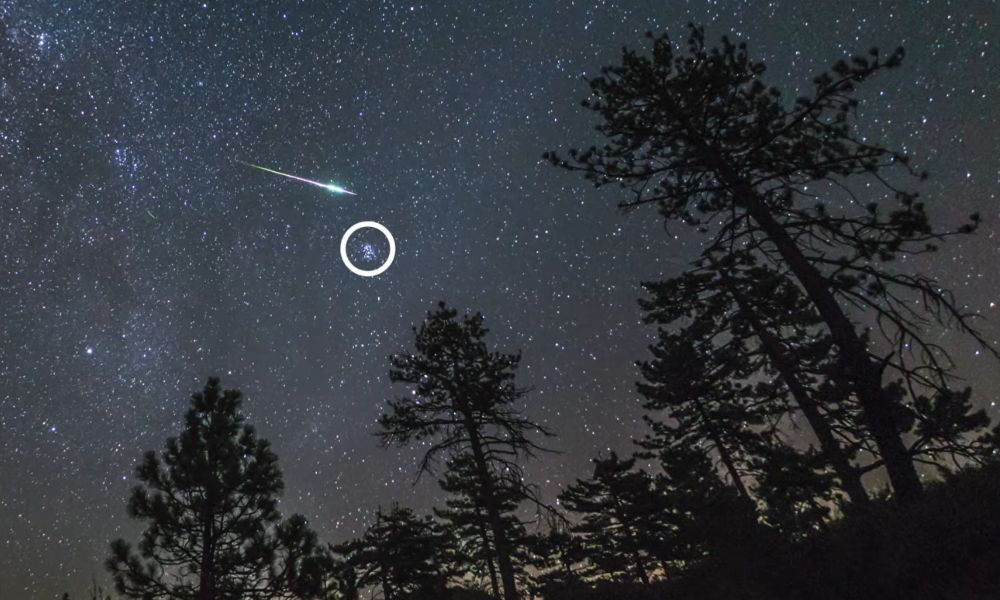
At 4 a.m. in late October, my backyard in Portland, Maine, smells like cold salt and wet leaves. I lie on a camping pad with notebook number 41 on my chest and a red flashlight. A streak crosses the sky in under a second, and I write down the time before I lose it.
That streak was a grain of dust from Halley’s Comet.
Its debris reaches us every October as the Orionid meteor shower. The 2026 peak falls on the night of October 21 to 22.
How Dust From an Old Comet Keeps Reaching Us
A comet is mostly ice mixed with rock and dust. Each time Halley swings close to the Sun, heat turns some of that ice to gas, and the escaping gas carries dust off the surface. NASA estimates that Halley loses 3 to 10 feet of its surface on every pass through the inner solar system.
The name itself has a much older story: the word comet comes from a Greek expression meaning “long-haired star”, inspired by the glowing tails that ancient observers saw in the sky.
Over many orbits, the loose grains spread along the path of the comet like crumbs along a hiking trail. Earth crosses that trail twice a year. The May crossing produces the Eta Aquariids, and the October crossing produces the Orionids.
So the meteors you see this month are not a fresh delivery from 1986. The grains have spread out over many trips around the Sun, which means any October night brings a mix of dust from many past visits.
Where Halley Is Right No
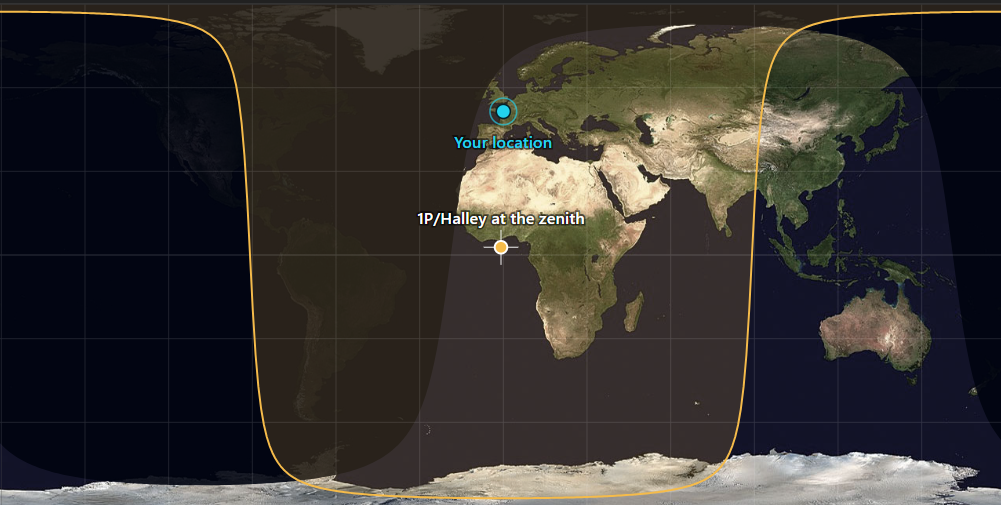
The tide chart on my fridge tracks a cycle measured in hours. Halley runs on a cycle of roughly 75 to 79 years, and right now it is on the long fall back toward us.
The comet turned around beyond the orbit of Neptune on December 9, 2023, about 3.3 billion miles from the Sun.
Halley’s Comet follows a long path around the Sun, traveling far beyond the outer planets before returning toward Earth. The video below offers a visual look at its remarkable journey through the solar system.
| Event | Date | Status |
|---|---|---|
| Last closest pass to the Sun | February 9, 1986 | Observed |
| Farthest point from the Sun | December 9, 2023 | Observed, moving about 2,000 mph |
| Orionid peak night | October 21 to 22, 2026 | Scheduled, dust only |
| Next closest pass to the Sun | July 28, 2061 | Predicted from its orbit |
Only the first two rows are history. The 2061 date is an orbital calculation, and forecasts suggest Halley could outshine most stars in the months after it rounds the Sun.
The Orionids in 2026, by the Numbers
I like a shower that comes with clear numbers. NASA lists the Orionids as active from October 2 to November 7 this year, so the season was already underway when I sat down to write on October 8.
If you’re planning to watch the Orionids this October, timing matters almost as much as finding a dark sky. The Instagram post below highlights the key dates and offers a quick reminder of when to look up.
View this post on Instagram
- The peak falls on the night of October 21 to 22.
- Under a dark, moonless sky, expect about 10 to 20 meteors an hour.
- The grains hit the air at about 41 miles per second, roughly 148,000 mph.
- The meteors seem to come from a point just north of Betelgeuse, the reddish shoulder star of Orion, but they can appear anywhere overhead.
- The best hours run from after midnight until dawn.
NASA offers a closer look at the Orionids, the annual meteor shower created by debris from Halley’s Comet. The video below provides additional context for this October skywatching event.
Those rates assume perfect conditions. A suburban yard with a porch light on will show fewer, and a sky with a bright moon fewer still.
The Moon Will Crowd the Peak This Year
The American Meteor Society lists the moon at 74 percent illuminated on peak night, a waxing gibbous that brightens the sky for much of the night. Moonlight does not hide every meteor, but it washes out the faint ones, and most Orionids are faint.
My opinion, and I will defend it, is that the trade is still worth an alarm clock. A waxing moon sets before sunrise, so the darkest window on peak mornings comes in the last few hours before dawn, when the radiant also stands high. Check the moonset time for your own town the evening before.
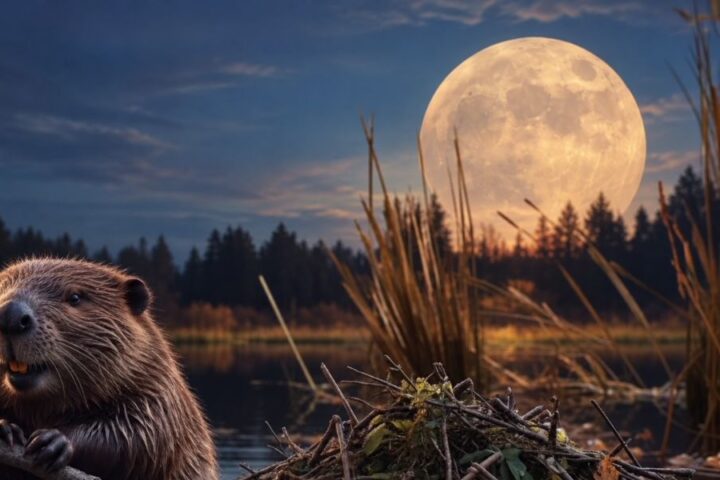
The moon turns full on October 26. The next full moon, the November Beaver Moon, rises after the shower has faded, so late October is the moonlit stretch you have to work around.
How I Watch, and How You Can Too

I learned the basics at folding tables outside Tucson, where my mother hauled me to backyard star parties.
The amateur astronomers told the kids to lie down for meteors, wait and stop asking what time it was.
- Get away from streetlights and porch lights.
- Lie on your back with your feet pointing southeast.
- Give your eyes about 30 minutes in the dark, and keep your phone in your pocket.
- Look 45 to 90 degrees away from Orion, where meteors appear longer.
That annual clock change also explains why the distinction between daylight saving and daylight savings keeps coming up every fall.
Did You Know a Sand Grain Makes the Whole Streak?
Most Orionid meteoroids are about the size of a grain of sand. At 41 miles per second, a grain that small slams into the upper atmosphere so hard that it heats the air around it and vaporizes.
A meteoroid is the grain while it is still in space. A meteor is the streak of light it makes in the atmosphere. A meteorite is any piece that survives to reach the ground.
Fast Orionids sometimes leave a train, a glowing trail of debris that can hang in the sky for several seconds or even minutes. A few flare into fireballs. I mark both in my notebook with a star, a habit left over from the desert, where a long train was the best thing that could happen to a nine-year-old at 2 a.m.
The Spacecraft That Flew Through the Dust
Much of what we know about where the dust starts comes from one encounter. On March 14, 1986, the European Space Agency flew its Giotto probe about 370 miles from the nucleus of Halley, roughly the distance from Portland, Maine, to Philadelphia. The probe logged about 12,000 dust impacts.
In 1986, ESA’s Giotto spacecraft gave scientists their first close-up look at Halley’s Comet. The footage below offers a rare glimpse of that historic encounter.
The images showed a lumpy nucleus about 9.3 by 5 miles. NASA lists its surface as reflecting only about 3 percent of the light that hits it, which puts it among the darkest objects in the solar system. Giotto also found the first evidence of organic material on a comet.
I was not alive for any of it. I know the encounter the way I know most of science, through the mission records and the people who did the work.
The Years the Orionids Broke Their Own Pattern
Ten years of first-Sunday walks on the same stretch of Maine shoreline taught me that the notes from last year make a weak forecast. The Orionids make the same point every few years. According to the American Meteor Society, peak rates in 2006 through 2009 climbed to 50 to 75 meteors an hour, while recent displays have been low to average.
A 2013 study by Aswin Sekhar and David Asher tied the strong Orionid years of 2006 to 2010 to a rhythm with Jupiter. In that rhythm, Halley circles the Sun once for every six orbits of Jupiter. Dust released while Halley sat in that pattern, between 1404 B.C. and 690 B.C., stayed bunched together instead of spreading thin.
Nobody has issued a forecast for another outburst in 2026. Treat the 10 to 20 per hour figure as the honest expectation, and anything more as a gift.
The Last Time People Panicked About Halley
Fear of comets is not new. On February 7, 1910, astronomers at Yerkes Observatory in Wisconsin announced they had found cyanogen gas in the tail of Halley, and Earth was expected to pass through that tail in May. The comet panic of 1910 followed.
Salesmen sold comet pills as protection against the gas. A Los Angeles broker sold comet insurance. Some people sealed their homes or hid in caves. May came and went, and nothing happened to anyone who stayed outside to look.
I hold a firm opinion here. Nature writing should leave people more curious, not more frightened, and the Orionids deserve curiosity. A sand grain burning up dozens of miles overhead is a show, not a threat.