

Before dawn one March morning in 1986, my father drove me up to Riverview Park in Pittsburgh to see Halley’s Comet. We stood in the cold for most of an hour, and what we finally found was a gray smudge low in the sky. My father said it looked like a thumbprint on a window. I asked why anyone called that a comet, and he said to ask my grandmother.
Comet Means Long-Haired Star
The Greeks called it astēr komētēs, the long-haired star. Komē (KOH-may) meant the hair of the head, and a related verb meant to let your hair grow long.
The Online Etymology Dictionary entry for comet traces the word from Greek into Latin cometa, then Old French comete in the 1100s, and into English around 1200.
A bright comet trails a glowing tail across the sky, and to people with no telescope, that tail looked like hair streaming behind a head.
Comet is not the only familiar word with a connection to the stars. The astrological origins of disaster, influence, and consider reveal how ancient beliefs about the sky shaped English vocabulary, although the connection for consider remains disputed.
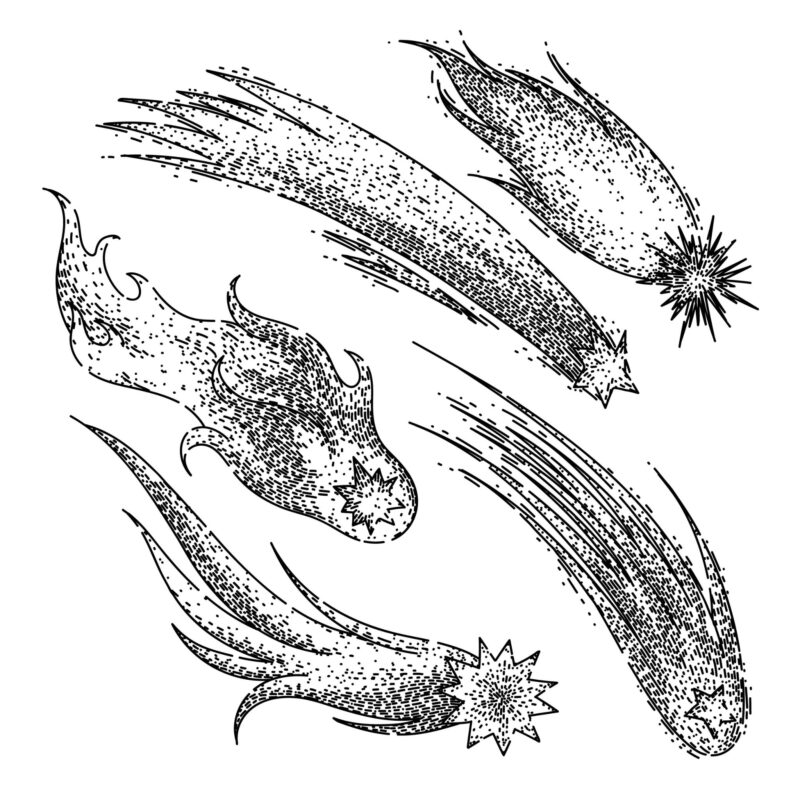
To see why ancient Greeks described comets as “long-haired stars,” watch this short video explaining their glowing tails, elongated orbits, and the debris they leave behind.
Astronomers still use the hair. The hazy cloud around a comet nucleus is called the coma, a sense recorded in English by 1765 and taken from Latin coma, “hair,” which goes back to the same Greek komē. The medical coma, a deep unconsciousness, comes from a different Greek word, kōma, “deep sleep.” The two coma entries share a spelling and nothing else.
English Once Called It the Haired Star
Before comet settled in, English speakers had their own description. The Anglo-Saxon Chronicle, as translated by J. Ingram, records under the year 678 a “comet-star” that shone every morning for three months, like a sunbeam.
The 1066 entry is better still. A chronicler wrote that some men said it was the star cometa, “which some men call the haired star.” The Old English phrase, as quoted in a word history by David Wilton, is þone fæxedon steorran. Both names, the borrowed one and the native one, sat side by side in the same sentence.
Did you know? The Old English word for hair, feax, survives in the English town of Halifax. A 16th-century reading turned the name into “holy hair” and produced a story about a murdered maiden. The etymology entry for Halifax says feax there probably meant rough grass, and the maiden belongs to folklore.
Other Languages Saw Other Shapes
Not everyone saw hair. Chinese astronomers often called comets broom stars, after the shape of the tail, according to the International Dunhuang Programme at the British Library. I am relying on that source here, not on any Chinese of my own.
| Language | Name | What the name describes |
|---|---|---|
| Greek | astēr komētēs | long-haired star |
| Latin | cometa | borrowed from Greek |
| Old English | fæxedon steorran | haired star |
| Classical Chinese | broom star | a sweeping broom |
| English, c. 1200 | comet | borrowed through French |
What Halley Actually Did in 1705
Edmond Halley discovered no comet and named none. In 1705 he published A Synopsis of the Astronomy of Comets, in which he used the new theory of gravity from Isaac Newton to compare the orbits of bright comets seen in 1531, 1607 and 1682.
The paths matched closely, so Halley argued they were one comet coming back about every 76 years. According to the NASA page on Comet 1P/Halley, he predicted it would return in 1758, and that prediction is why the comet carries his name.
Edmond Halley’s work went far beyond the comet that bears his name. This short video explores his contributions to astronomy, his connection to Isaac Newton, and the prediction that made him famous.
The claim was a bet that comets obey the same laws as planets. Before it, many European scholars still followed Aristotle, who had treated comets as burning vapor near Earth, not as bodies among the planets. After it, a comet could be scheduled.
The Name Arrived After Halley Died
Halley never saw his prediction tested, and he did not attach his own name to anything. The name came from other astronomers once the comet kept its appointment. The dated stops run like this.
- 1742. Halley dies at 85, more than 16 years before the predicted return.
- December 25, 1758. Johann Georg Palitzsch, a farmer and amateur astronomer near Dresden, sees the comet on Christmas night, as a 1986 history of the comet in Aramco World recounts.
- March 13, 1759. The comet makes its closest pass to the Sun, delayed by the pull of Jupiter and Saturn.
- 1759. The French astronomer Nicolas-Louis de Lacaille calls it after Halley, and the name sticks.
So Halley lent his name to a comet the way a person lends a name to a scholarship, by being remembered afterward.
People Watched It Long Before Halley
The comet had been visiting for thousands of years before anyone predicted it.
- The earliest certain record comes from China in 240 B.C., in the Records of the Grand Historian.
- Babylonian observers noted it in 164 B.C. and 87 B.C., according to the Aramco World history.
- The Bayeux Tapestry shows it over England in 1066, with men pointing upward under the Latin words ISTI MIRANT STELLA, which a University of Nevada, Las Vegas astronomy page translates as “these ones are looking in wonder at the star.”
- Chinese scribes were drawing comets of every kind in the second century B.C. A silk manuscript from a tomb dated to 185 B.C. sketches 29 comet shapes, according to the British Library project.
Ancient Babylonian astronomers recorded comet sightings centuries before Edmond Halley calculated their periodic return. This short video explores how their observations helped preserve the early history of Halley’s Comet.
Even the tapestry, made by people who likely knew the word cometa, settled for stella. To the people stitching it, a star with hair was still a star.
How Comets Get Their Names Today
Modern comets usually carry the names of their discoverers, and a code tells you what kind of comet it is. The European Space Agency explains the system in two main letters.
- P/ marks a periodic comet, with an orbit under 200 years or more than one confirmed pass by the Sun. Halley is 1P because it was the first such comet.
- C/ marks a comet on a longer or one-time path, such as C/1995 O1, better known as Hale-Bopp.
Under guidelines the Minor Planet Center applies, adopted in 2003, a comet should preferably carry no more than two discoverer names.
A few comets honor the person who worked out the orbit instead. Comet 2P/Encke was first spotted by Pierre Méchain in 1786, but it carries the name of Johann Franz Encke, who showed that later sightings were the same object.
At the End
The smudge my father and I saw was almost certainly the coma, the long-haired star with its hair cut short by a poor viewing year.
The comet reached its closest point to the Sun on February 9, 1986, and it will not return until a predicted July 28, 2061.
View this post on Instagram
Its dust comes back sooner. The Orionid meteors, debris from Halley, peak on the night of October 21 to 22, as our guide to Halley and its October dust explains. I plan to stand on a Chicago rooftop that night and count a few strands of hair from the comet my father called a thumbprint.