

A weather service declares a storm a disaster. City councils agree to consider proposals, and sneaker brands sign another influencer.
None of the people involved is thinking about planets, yet all three words came into English with a piece of astrology inside them, or so the popular story goes.
We checked that story against dated dictionary entries, early printed sources and the published work of Latin etymologists.
Two of the three star origins hold up well. The third rests on a guess that scholars still argue about, and we think readers deserve to know which claim is which before they repeat it.
Disaster Meant a Bad Star Before It Meant a Bad Day

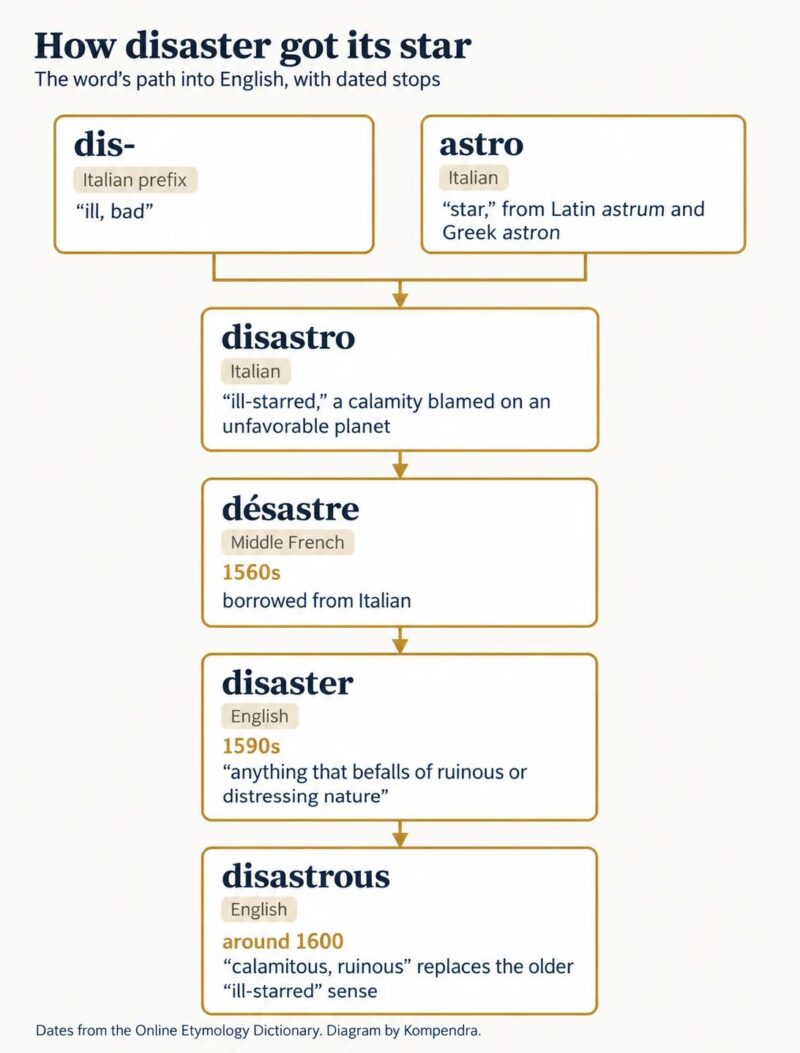
Disaster reached English in the 1590s, according to the Online Etymology Dictionary entry for disaster. It came through Middle French désastre, recorded in the 1560s, which French had borrowed from Italian disastro (dee-ZAH-stroh).
The Italian word joins dis-, a prefix meaning “ill,” to astro, “star.” A disastro was an ill-starred event, a calamity blamed on a planet sitting in an unlucky position. Medieval Latin expressed the same idea with astrum sinistrum, “unlucky star.”
The adjective shows how fast the stars dropped out. Etymonline dates disastrous to the 1580s, a decade ahead of the noun, with the sense “ill-starred.” By around 1600 it already meant “calamitous, ruinous,” with no planet required. English speakers, in short, stopped hearing the star within a generation of adopting the word.
Shakespeare Was Already Laughing at the Star Sense
King Lear was written around 1605 and 1606 and performed before King James I on December 26, 1606.
In the second scene, Gloucester frets that recent eclipses of the sun and moon bode ill. His son Edmund waits until the old man leaves, then mocks the whole idea.
“we make guilty of our disasters the sun, the moon, and the stars” – Edmund in King Lear, Act 1, Scene 2
Readers can find the line in the full text of King Lear on Project Gutenberg. It matters for dating. Barely a decade after disaster entered English, a popular playwright could expect a London audience to hear the star theory as an excuse.
Edmund is the villain of the play, but on this point the record sides with him. People did blame the sky, and the word kept its star even after the habit began to look foolish on stage.
Influence Was a Fluid the Stars Poured Into People
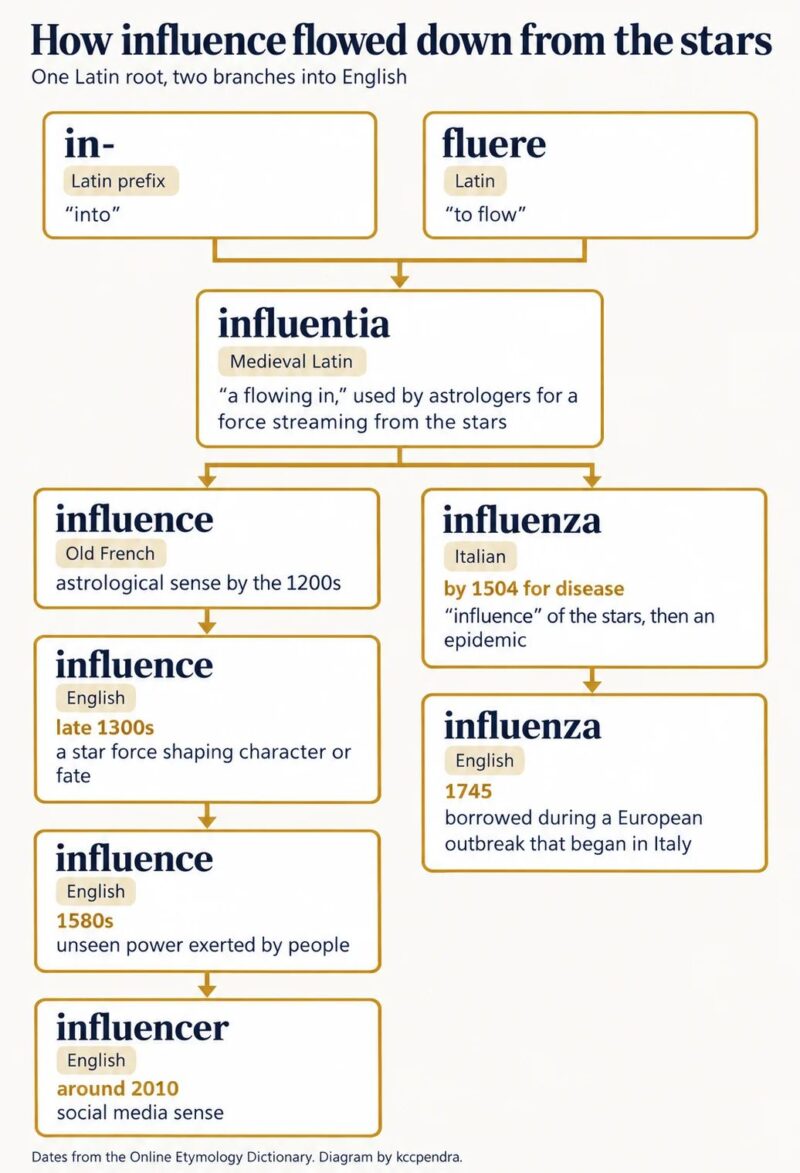
Influence has the strongest star credentials of the three. Medieval Latin influentia meant “a flowing in,” from Latin influere, “to flow into.”

Astrologers used it for an invisible stream believed to pour from the heavens into human bodies and fates, and Old French carried that astrological sense by the 1200s.
The Etymonline history of influence lets us follow the English word stop by stop.
- Late 1300s. Influence enters English as an astrological term for a force from the stars acting on character or destiny.
- 1580s. The word starts to describe unseen power exerted by people.
- 1650s. Influence becomes a verb.
- 1866. Under the influence is first recorded with the meaning “drunk.”
By our count, the human meaning needed about two centuries to catch up with the celestial one, which makes influence the slowest of our three words to come down to earth.
The Flu Still Carries the Old Star Theory
The same Medieval Latin root took a second road through Italy. Italian influenza first meant a visitation or influence of the stars, and Italians applied it to outbreaks of disease at least by 1504, as in influenza di febbre scarlattina, a scarlet fever epidemic.
English borrowed the word in 1743, during a European outbreak that began in Italy. According to the Etymonline entry for influenza, The Gentleman’s Magazine reported it that year as “the Influenza.”
A marketing sense, a small group whose habits set trends, appeared around 2000, and the online sense arrived by about 2010, as the Etymonline entry for influencer records. Every sponsored post carries a job title borrowed from medieval astrology.
Consider Has the Weakest Claim to the Stars

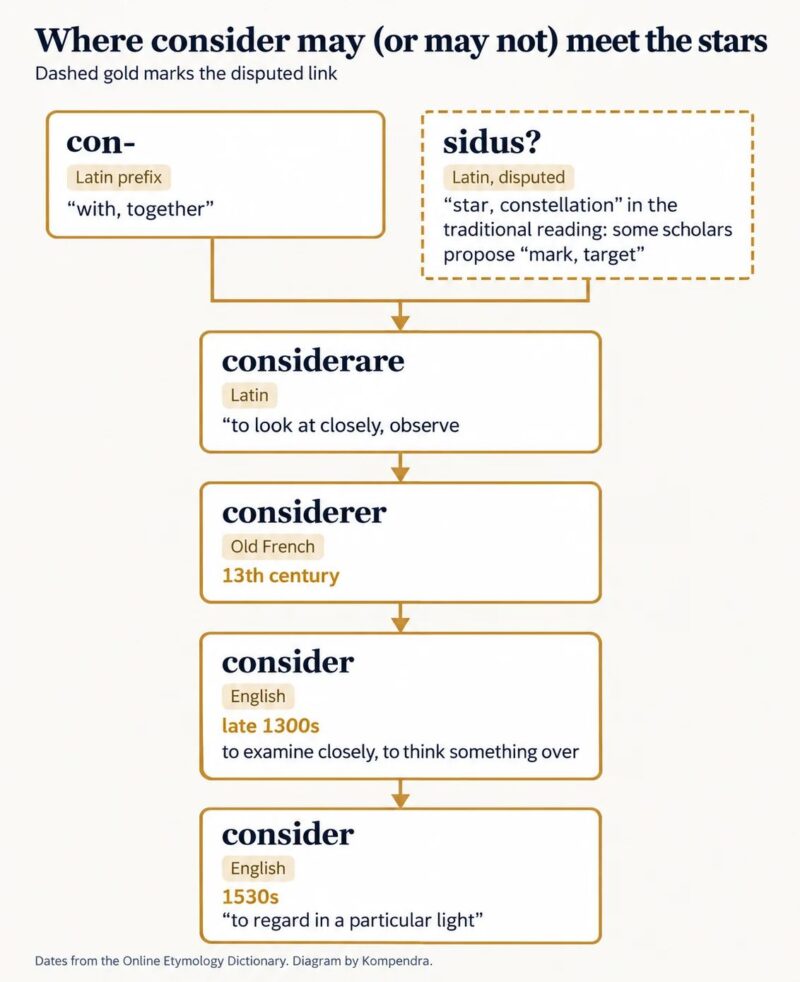
Consider entered English in the late 1300s from Old French considerer, from Latin considerare, “to look at closely, observe.”
The traditional analysis splits the Latin verb into com-, “with,” and sidus (SEE-doos), “star” or “constellation.”
The Etymonline entry for consider suggests the verb may first have described watching the sky, perhaps by sailors or by Romans reading omens.
That is a hypothesis, not a record. None of the dictionaries we checked cites considerare in a stargazing sense, and the English word meant careful thought from its first appearance.
In the 20th century, the classicist T. G. Tucker doubted the sidus link, and Michiel de Vaan, in his 2008 etymological dictionary of Latin, weighed several origins without endorsing any.
Merriam-Webster editors also describe a newer proposal that sidus once meant “mark” or “target.”
How the Three Words Compare on the Evidence
We built the table below from the dated entries cited in this article, then added our own judgment on each link to the sky. Desire appears too, because it shares the disputed Latin root of consider.
| Word | Route into English | First English record | Star element | Our verdict |
|---|---|---|---|---|
| disaster | Italian, then Middle French | 1590s | astro, “star” | Certain |
| influence | Medieval Latin, then Old French | Late 1300s | influentia, an astrology term | Certain |
| consider | Latin, then Old French | Late 1300s | sidus, “star,” disputed | Possible, unproven |
| desire | Latin, then Old French | Around 1200 | sidus, “star,” disputed | Possible, unproven |
Where We Land on the Stargazer Story
In our view, the headline idea survives with one asterisk. Disaster and influence are genuine leftovers of astrology, and the evidence for both is dated and direct. Consider belongs on the list only with a question mark beside it, and we would rather leave it there than oversell the story.
- Share the disaster story freely, since the Italian parts and the dates line up.
- Tell the influence story with its best detail, the shared root with influenza.
- Present the consider story as a possibility. Claiming the word once meant consulting the stars goes further than any dictionary we checked.
The moon left similar marks on everyday speech, which we traced in our piece on lunatic, Monday and the moon in English.
The night sky reaches into names as well, as our look at how the comet got a Greek name for long hair shows.
Back to the Storm Warning
When a forecaster calls the next hurricane a disaster, the word repeats a 16th-century Italian diagnosis, a bad star overhead. A doctor who confirms influenza uses a label carrying an old Italian belief that epidemics descended from the sky. Neither speaker means any of it, and neither needs to.
Words mean what people use them to mean now, and an old sense is history rather than a rule. Consider deserves a lighter touch, though. Before repeating that it once meant reading the heavens, open the dictionary entry and notice the word “perhaps.” That small hedge is the most honest part of the story.
The questions that come up
1. Why Do We Say Flu Instead of Influenza?
Speakers clipped it within a century. The Etymonline entry for flu records flue in 1839 and the modern spelling from 1893.
2. Is Sidereal Related to Consider?
Partly. Sidereal certainly comes from Latin sidus, while consider only may. Sidereal entered English in the 1630s through French sidéral, and nobody questions its star.
3. Were Astrology and Astronomy Separate When These Words Arrived?
Not yet. Astrology entered English in the late 1300s covering observation and forecasting alike. Only by the late 17th century did it narrow to reading human destiny in the stars.
4. Did Ancient Romans Use Influence in the Star Sense?
No. Classical Latin influere simply meant “to flow into.” The astrological noun influentia belongs to Medieval Latin.
5. What Did English Speakers Say Before Borrowing Disaster?
English had native words for calamity. The early Middle English lond-sorwe, “land-sorrow,” described a national catastrophe around 1200.