
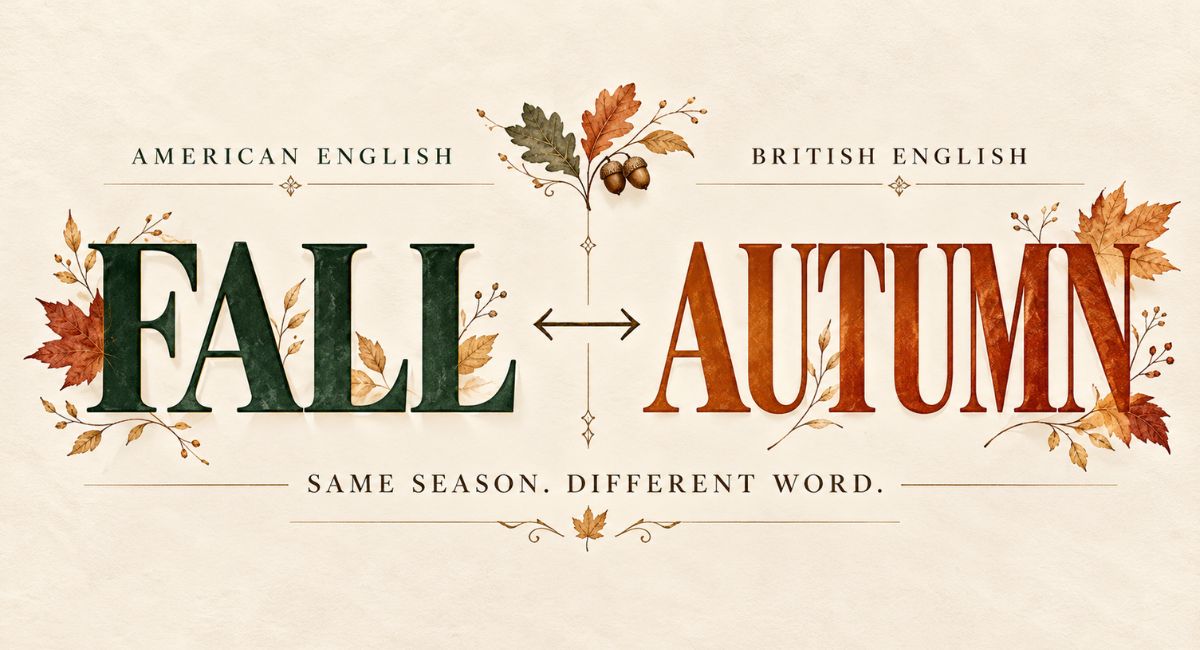
On a No. 22 Clark Street bus last October, I wrote down a conversation from the seat ahead of me. A woman with a London accent said the trees in Lincoln Park were finally looking autumnal.
Her friend, a Chicagoan by the sound of her, answered that fall had come late this year. They were describing the same maples in two different words, and neither one stopped to translate.
The usual explanation says Americans kept the old English word while Britain switched to a fancy French one. The dates say otherwise. Autumn is the older of the two, and American books did not settle firmly on fall until the 1800s.
Harvest Was the Season Before Either Word
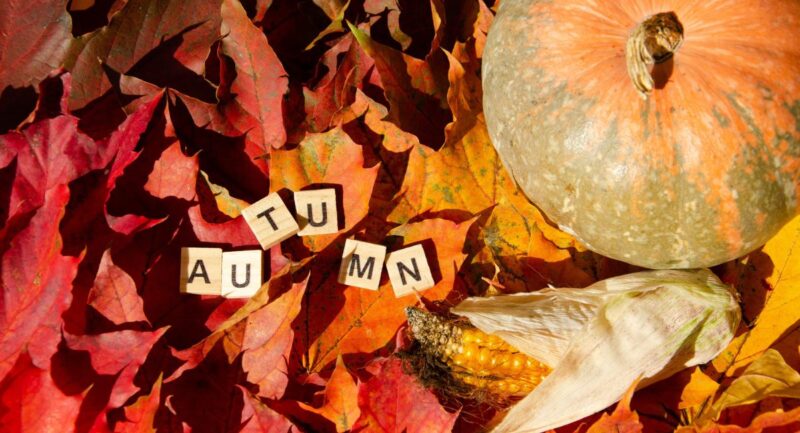
The first English name for the season was harvest. In Old English, hærfest named one of the four seasons, and the link to cutting grain was only implied.
The Online Etymology Dictionary entry for harvest dates the sense “time of gathering crops” to the middle of the 1200s.
After about 1500, the word narrowed. Harvest came to mean the work and the crop itself, and the season needed new names.
The old meaning survives in the moon calendar, where the Harvest Moon is followed by the Hunter’s Moon, which peaks on October 26.
English has plenty of words whose meanings changed as they traveled. The story behind the word turkey is another example, involving an African bird and a case of mistaken identity.
Did you know? German never gave the season away. Its word for autumn is Herbst, and it comes from the same Proto-Germanic root as English harvest. A German speaker saying “autumn” is still, in effect, saying “harvest,” the way English speakers did a thousand years ago.
Autumn Arrived From French in the 1300s
Autumn reached English in the late 1300s, spelled autumpne, from Old French autompne.
Behind that sits Latin autumnus, whose own origin nobody has pinned down.
The etymology entry for autumn notes that it may come from Etruscan, and that Latin scholars disagree about its root.

The modern spelling settled in the 1500s, and Chaucer had used the word long before Shakespeare did. By the time the first English colonists sailed for Virginia, autumn had been in English writing for more than two centuries.
The n at the end of autumn (AW-tum) is silent, but it comes back when the word grows a suffix. Autumnal is said aw-TUM-nul, the same pattern as column and columnist. The spelling keeps a sound that English speakers dropped centuries ago.
Fall Started as the Fall of the Leaf
The phrase behind fall is plain description. Leaves drop, and the season took its name from that.
The dictionaries agree on the image but not on the date the short form appears, and I am listing both readings rather than picking one.

The Online Etymology Dictionary entry for fall records fall of the leaf from the 1540s and fall alone from the 1660s.
Dictionary.com, in a 2023 history of the season names, places recorded use of fall in the 1500s and says it was common in England until about the end of the 1600s.
The English poet John Dryden wrote “last fall” in a couplet about a town doctor, a line the 1913 Webster unabridged dictionary still uses to illustrate the season sense.
Either way, fall is the younger word, by roughly 150 to 300 years.
The Popular Story Gets the Order Backward
I understand why the usual version spreads. It flatters Americans as keepers of an older, plainer English, and it gives the British a whiff of French refinement. A good story, but the record does not support its first claim.
Both words were in English mouths in the 1600s, and autumn had the longer pedigree. When Samuel Johnson published his dictionary in 1755, he did include the season sense of fall, but only as the thirteenth meaning of the noun. Ryuichi Hotta, a historian of English at Keio University, reads that placement as a sign the sense was already minor in Britain.
The video below takes a closer look at how fall became the preferred American term and why British English continued to favor autumn, tracing the linguistic history behind the difference.
So the colonists did not carry over a word that Britain later abandoned on purpose. They carried both, and the two countries leaned in different directions afterward.
What Two Centuries of American Books Show
By 1816 the American preference was clear enough to record.
John Pickering published a vocabulary of supposed Americanisms in Boston and passed along a remark that the season was “universally called the fall” in North America.
I wanted to see when the printed record caught up, so I compared fall and winter with autumn and winter in the American and British corpora of the Google Books Ngram Viewer.
| Year | Fall share, American books | Fall share, British books |
|---|---|---|
| 1800 | 38% | 6% |
| 1850 | 56% | 4% |
| 1900 | 85% | 4% |
| 1950 | 94% | 2% |
| 2000 | 84% | 15% |
Printed books in 1800 still leaned toward autumn, even in America. Speech probably ran ahead of print, and early American publishing reprinted many British books, so treat the first rows as a floor.
British books show fall creeping up to 15 percent by 2000, which fits growing American influence, though this method cannot prove the cause.
Why Britain Let Fall Go
Here the honest answer is that nobody has a dated explanation.
Even the Merriam-Webster usage note on autumn and fall says it is not sure why the split happened.
The ideas in circulation are hypotheses, not findings.
- Contact between American and British speakers thinned after the colonies were settled, so the two varieties drifted apart.
- After independence, American usage became part of national identity, and Americans had less reason to follow London.
The Met Office, the national weather service of the United Kingdom, puts it simply in its 2026 guide to when autumn starts.
Autumn became the standard British term, and fall is remembered as coming from the falling leaf.
At eight, I once filled FALL into a Pittsburgh crossword and owed my grandmother its origin before she let the ink dry. I could not have explained this part, and I still cannot.
Weather Agencies on Each Side Still Split
The governments use their own words for the same three months. In the United States, NOAA reports on “meteorological fall,” September through November.
Weather agencies also follow international naming rules for major storms. The history of why hurricanes get human names shows how meteorologists moved from informal labels to internationally agreed lists.
Its December 2025 climate report ranked fall 2025 as the third-warmest on record for the contiguous U.S., at 57.2°F, or 3.7°F above the 20th-century average.
The Met Office uses the same September 1 to November 30 window and calls it meteorological autumn. The calendar is identical. Only the label changes across the Atlantic.
American clocks carry the word too. The memory aid “spring forward, fall back” works because fall is both the season and the motion, and the next backward step comes at 2 a.m. on November 1, as our guide to the November 1 clock change explains.
Which Word Should You Use
My view, and it is a view rather than a rule, is that both words are correct everywhere English is spoken.
Americans use fall for the calendar and save autumn for a dressier register, as in autumnal colors or the autumn of a career.
British readers understand fall perfectly well, even if they would not write it in a school report.
The video below offers a practical English lesson on vocabulary associated with fall and autumn, showing how these seasonal terms appear in everyday conversation.
Other languages have kept the older pattern. Irish calls the season fómhar, and the Ó Dónaill dictionary, which I rely on here rather than any Irish of my own, glosses it as both “autumn” and “harvest season.”
The entry for fómhar even lists the work of reaping under the same word, much as Old English hærfest once covered both.
Back to the Bus on Clark Street
Read with dates, that bus conversation ran on two different clocks. The Londoner used a word that reached English from Old French in the late 1300s.
The Chicagoan used a younger one, first recorded in the 1500s or 1600s depending on the dictionary, which Americans made their own during the 1800s.
Neither woman was wrong, and neither needed a translator. Had I leaned forward to mention that the oldest name of all was harvest, I suspect they would have changed seats.
The line stayed in my notebook instead, filed under words that crossed the Atlantic and came back wearing different clothes.
English has other familiar words whose histories are easy to overlook. Even the everyday farewell goodbye began as “God be with ye” before centuries of everyday speech changed its form.