
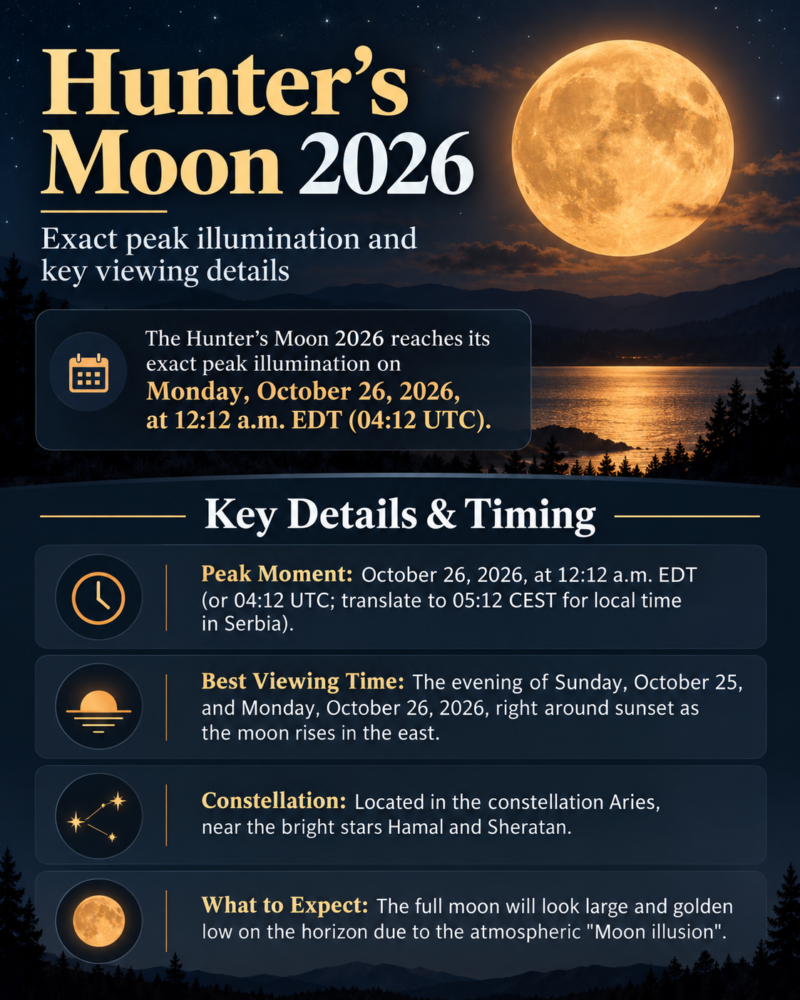
The U.S. Naval Observatory puts the moment at 04:12 Universal Time on Monday, October 26, 2026.
On the East Coast that is 12:12 a.m., twelve minutes into Monday, which explains the October 26 headlines. In the Central, Mountain and Pacific time zones, the Hunter’s Moon turns full on Sunday night, before the calendar flips.
I pencil moonrise times into a pocket calendar every October, a habit that started with the almanacs that turned up in estate boxes at the bookshop my grandfather ran in southern Ohio.
The October page always carried the same promise, light for hunters before the cold. That promise is older than the almanacs, and less tidy.
When the Hunter’s Moon Is Full Where You Live
A full moon is a single instant, not a whole night.
The USNO table of 2026 moon phases gives 04:12 Universal Time on October 26, and each U.S. clock converts that differently, with daylight saving time still in effect until November 1.
- Eastern time, 12:12 a.m. Monday, October 26
- Central time, 11:12 p.m. Sunday, October 25
- Mountain time, 10:12 p.m. Sunday, October 25
- Pacific time and most of Arizona, 9:12 p.m. Sunday, October 25
- Alaska, 8:12 p.m. Sunday, October 25
- Hawaii, 6:12 p.m. Sunday, October 25
NASA marks October 25 on the moon chart in its What’s Up guide for October 2026, while most news sites went with October 26. Both are right. They are simply standing in different time zones.
Sunday Evening Is the Best Time to Look
For watching, the rise matters more than the instant.
From Providence, where I live, the Naval Observatory puts sunset at 5:49 p.m. on Sunday, October 25, and moonrise at 5:13 p.m., so the moon is already up as the light fades.
Anyone can run the same numbers for their own town with the USNO one-day sun and moon calculator.
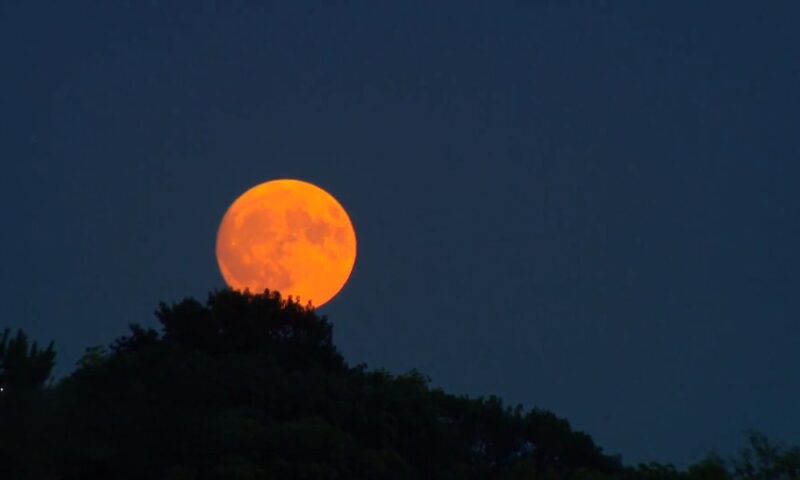
Look low in the east. Over the night the moon drifts from Pisces into Aries, and Saturn sits a little more than 20 degrees to its south for U.S. viewers, according to the Space.com guide to the October 2026 full moon. On the night of October 27 into 28, the moon slides past the Pleiades, the small star cluster also called the Seven Sisters.
No telescope is needed for any of it. A clear eastern horizon helps more than binoculars, and in Providence the eastern horizon is mostly rooftops.
Why the Moon Seems to Wait for Hunters
The practical heart of the name is timing. Over a month, the moon rises later each evening, which leaves a widening dark gap after sunset. Around the autumn full moons, that gap opens slowly, and the Providence figures show it plainly.
On Saturday, October 24, the moon rises at 4:47 p.m. The next three evenings follow at 5:13, 5:45 and 6:24 p.m., delays of 26, 32 and 39 minutes, while sunset holds near 5:48 p.m. Not until Wednesday, October 28, does the delay stretch to 50 minutes, with moonrise at 7:14 p.m.
Curiosity: For four evenings running, anyone in southern New England working outdoors after supper finds a nearly full moon either already up or rising within 40 minutes of sunset. Nobody has to wait up for it. The almanac promise rests on that small piece of arithmetic, not on any special brightness.
Where the Name Hunter’s Moon Comes From
Hunter’s Moon is an English name, and an old one. Its earliest recorded use dates to 1710, according to the Oxford English Dictionary, as a 2021 Live Science report republished by Space.com explains. Harvested fields come first in most versions of the story.
The Moon has also left its mark on everyday English, shaping familiar words such as Monday, month and lunatic through centuries of language change.
Once the crops were in, deer and smaller game were easier to spot across bare stubble, and the animals had fattened through summer and early fall. The Old Farmer’s Almanac ties the name to hunting and preparing meat for winter, with the early moonrise adding working light at the end of a short day.
I trust that explanation because it is plain. It asks nothing of the moon except that it show up early, which, as the Providence numbers show, it does. Getting meat put by before winter was a household deadline, not a romance.
CBS Minnesota explores the Hunter’s Moon and its traditional connection to autumn hunting.
The Native American Names Reached Print Through Almanacs
Many October lists also give names attributed to Native American nations. In the 1930s, the now-defunct Maine Farmer’s Almanac published Native American moon names, including Travel Moon, Dying Grass Moon and Sanguine or Blood Moon for October, according to the same 2021 report.
An AccuWeather explainer on the name, citing the Old Farmer’s Almanac, links Hunter’s Moon itself to Algonquin hunting ahead of winter. The Old Farmer’s Almanac now lists several others.
- Drying Rice Moon, from the Dakota
- Falling Leaves Moon, from the Anishinaabe
- Freezing Moon or Ice Moon, from the Ojibwe and Haida
- Migrating Moon, from the Cree
My opinion, for what it is worth, is that any list headed “the” Native American name deserves a second look. Hundreds of nations kept their own calendars in their own languages, and an almanac editor is a filter, not a witness.
The Harvest Moon Comes First
The Hunter’s Moon is defined by the moon before it. By the usual rule, the Harvest Moon is the full moon closest to the autumn equinox, and the Hunter’s Moon is the next one. In 2026, the equinox fell at 00:05 Universal Time on September 23, or 8:05 p.m. Eastern on September 22, according to the USNO table of 2026 equinoxes and solstices.
The word harvest once named the entire season in Old English, long before the terms fall and autumn developed their different roles in American and British English.
The September full moon followed on September 26, less than four days later. It took the Harvest Moon title, and October inherited the hunters.
In some years the October full moon lands closer to the equinox than the September one. October then becomes the Harvest Moon, the September moon is usually called the Corn Moon, and the Hunter’s Moon moves into November.
Lists that print one fixed name per month skip that rule. It belongs in my notebook of confident statements that are only usually true.
Moonlight Does Not Extend Legal Deer Hunting Hours
Here the old name and modern law part ways. In the southern Ohio river town where I grew up, the October almanac page and the deer season dates were read side by side, but the moon was never part of the legal schedule.
Wildlife biologist Dr. Bronson Strickland discusses research on how moon phases, position and brightness may influence whitetail deer movement.
“It is unlawful to hunt or take deer at any time except from one-half hour before sunrise to one-half hour after sunset.” From Ohio Administrative Code rule 1501:31-15-11, effective July 6, 2026.
Under that rule, a bright Hunter’s Moon adds nothing to legal deer hunting in Ohio. Other states write their own hours, seasons and exceptions, and they can differ by species and by method. Anyone heading out the week of October 25 should check the current regulations from their own state wildlife agency, not the sky.
What Else Is in the October Sky
The Hunter’s Moon shares October with several other sights, and none of them needs equipment. NASA points to three worth planning around.
- Saturn reached opposition on October 4 and still rises around sunset, so it keeps the moon company for much of the night.
- The Orionid meteor shower peaks the night of October 21 into 22, though a bright waxing gibbous moon will wash out the fainter meteors.
- The best Orionid viewing comes a few hours before dawn, after the moon has set.
The Orionids are dust left behind by Halley’s Comet, and NASA lists the 2026 Orionid shower as active from October 2 to November 7. By the night of the full moon, the shower is past its peak but not finished.
The Next Moon Already Has a Name Waiting
The next full moon arrives on November 24, 2026, at 14:53 Universal Time. Eastern clocks will read 9:53 a.m., since the clocks go back on November 1. That moon is the Beaver Moon, named for trapping before the ice.
In Providence that evening, the sun sets at 4:19 p.m. and the moon rises at 4:01 p.m., the same early schedule on a shorter day.
What still nags at me is the 1710 citation. The dictionary gives a year, and I would like to know who first wrote Hunter’s Moon in English, and whether that person carried a gun or only a pen.