


The first dictionary I ever owned came from a church sale in Pittsburgh when I was fourteen, and it is still on my shelf.Its entry for November gives two facts side by side.
The eleventh month of the year, from Latin novem, “nine.” Next to it, in my teenage pencil, is a large question mark.The answer took me years to piece together properly.
November (noh-VEM-ber) was the ninth month in a Roman year that began in March.When January and February ended up at the front, the old number names stayed where they were.
How and when that happened is where the sources start to argue.
For a quick visual explanation of why November means “nine” despite being the eleventh month, watch this short video exploring the origins of its name in the Roman calendar.
Counting From March Makes November the Ninth
Start the year in March and count. The Online Etymology Dictionary traces November to Latin novem, “nine,” and notes that the Roman calendar it names began in March.
Six Roman months carried plain number names, and every one of them now sits two places later than its name says.
| Latin name | Number it contains | Position counting from March | Position today |
|---|---|---|---|
| Quintilis (now July) | Five | 5th | 7th |
| Sextilis (now August) | Six | 6th | 8th |
| September | Seven | 7th | 9th |
| October | Eight | 8th | 10th |
| November | Nine | 9th | 11th |
| December | Ten | 10th | 12th |
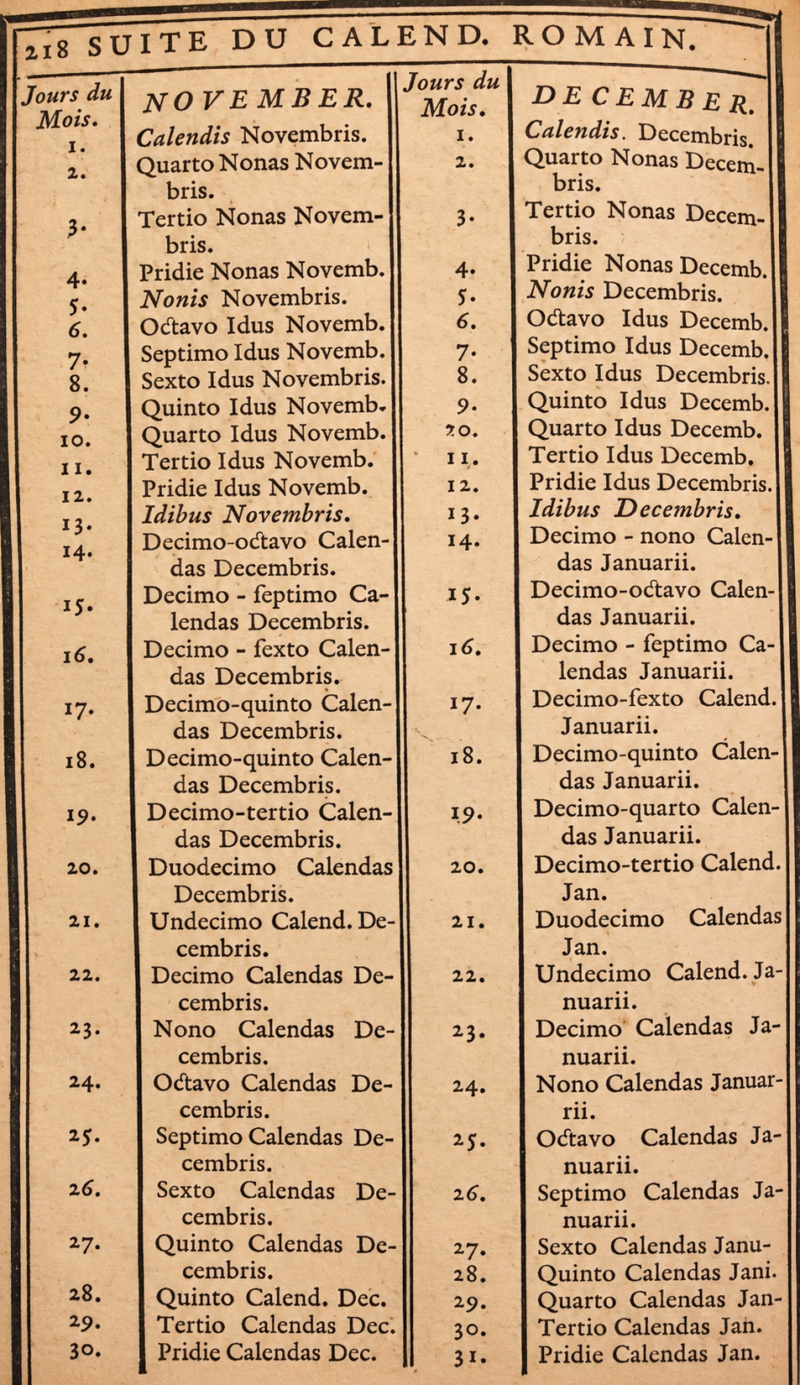
The gap is always exactly two, the two months that now come before March.
Quintilis and Sextilis lost their numbers when Rome renamed them for Julius Caesar and Augustus.
The last four kept theirs, so the mismatch survives into every modern calendar.
Did You Know Roman Writers Described a Ten-Month Year?
The traditional story credits Romulus, the legendary founder of Rome, with a year of only ten months, March through December.
The poet Ovid told it this way in his calendar poem, the Fasti, written in the early first century A.D.
“He determined there’d be ten months in every year.” Ovid, Fasti, Book 1, in the translation by A. S. Kline.
Ovid goes on to say that Numa, the second king, “added two months to the ancient ten.”
Encyclopaedia Britannica summarizes the same tradition, describing an original Roman calendar of 10 months and 304 days, with January and February added later.
A 304-day year falls about two months short of the sun, which is roughly the span of the two missing months. Britannica also adds that February was moved to sit between January and March in 452 B.C.
The Ancient Writers Did Not Agree on the Details
My grandmother taught me never to ink in an answer until I could explain it.
The Roman sources would have frustrated her, because they do not tell one story.
A 19th-century reference, Smith’s Dictionary of Greek and Roman Antiquities, collects the disagreements.
- Censorinus and Macrobius, writing centuries after the fact, give Romulus a ten-month year of 304 days.
- Plutarch agrees on ten months, but in his life of King Numa he says the early year was meant to last 360 days, with some months under 20 days and others 35 or longer.
- Macrobius reports that the leftover winter days simply went unnamed.
None of these writers saw the early calendar in use. They were explaining old customs and old names hundreds of years later, often by working backward from the names themselves.
Some Modern Scholars Doubt the Ten-Month Year
That backward reasoning is exactly what worries Peter Heslin, a classicist at Durham University.
In a 2020 Live Science report on the month names, he argued that the Roman year probably always had 12 months.
He called it strange to design a calendar with a two-month winter gap nobody named.
Heslin suggests the names point to a New Year that slid backward. Romans long celebrated the new year in March, while the state shifted to January.
From 153 B.C., the consuls, the two top officials elected each year, began their term on January 1. Over time, the official start became the popular one.
My view, labeled as opinion, is that the evidence supports one firm fact. Rome once counted its year from March. Whether that year had ten months or twelve is still an open question.
When January Moved to the Front
Even the reference books I trust most date the change differently, because they describe different steps in a long process. I lined up three of them.
Britannica follows the legend and credits King Numa, the second king of Rome, with adding January and February. Heslin points to 153 B.C., when the consuls began serving from January 1. The Online Etymology Dictionary entry for September ties the shift to the Julian reform of 46 B.C., when Julius Caesar overhauled the calendar.
The three dates do not cancel each other out. One describes when the months were said to be added, one when officials started their year in January, and one when the reformed calendar fixed January 1 for good. November had been out of position through all of it, and nobody changed its name to match.
Roman Emperors Kept Trying to Rename the Month
Affection is not what kept the number names. They survived several attempts to replace them with imperial names.
- Tiberius was born on November 16. According to Cassius Dio, the Senate asked to rename November after him, and Tiberius replied, “What will you do, then, if there are thirteen Caesars?”
- Domitian renamed September and October as Germanicus and Domitianus. Plutarch notes that the old names returned after Domitian was killed.
- Commodus went further and renamed all twelve months after his own titles, according to Dio. In the order Dio lists them, the eleventh name is Romanus.
Each renaming depended on one ruler and died with him. A plain number offended no one, which may be why it outlasted them all.
English Called It Blood Month Before It Said November
English did not always use the Latin name. In the 700s, the Northumbrian monk Bede listed the old English month names in his book on reckoning time. In the passage translated by Faith Wallis, November is Blodmonath.
November is hardly the only familiar calendar word with an ancient history. Even Monday and month preserve old connections to the Moon, showing how early ways of measuring time still shape English vocabulary.
Why did the Anglo-Saxons call November the “Month of Blood”? This video explores the old English tradition behind the name and how communities prepared for the coming winter.
The Online Etymology Dictionary glosses the name as “blood month” or “month of sacrifice.” Bede explains that it was the month when cattle about to be slaughtered were dedicated to the gods.
The practical side is easy to see. Animals that could not be fed through winter were killed in late autumn, and the meat was stored.
The same season gave November its full moon name. The Beaver Moon reflects the same rush to prepare before winter closed in. November itself arrived in English around 1200, from Old French novembre and directly from Latin.
Other Languages Named the Month for the Season
Not every language took the Roman number. Several kept names describing what November looks like where they live.
Polish and Czech call it listopad, from words for “leaf” and “fall.” Lithuanian lapkritis also means leaf-fall. Croatian studeni comes from a root for “cold,” and Finnish marraskuu is usually explained as “death month.”
Those names can drift between months as easily as the Latin ones did. Macedonian uses a form of listopad for October, a reminder that leaves do not fall on one shared date across Europe.
I think the seasonal names and the Latin number tell the same kind of story. Each records what mattered to the people who named the month, whether that was falling leaves or a place in the count from March.
November is not the only familiar name with a misleading history. Even the turkey’s name comes from a centuries-old mix-up involving an entirely different bird.
The Question Mark in the Margin
I took that church-sale dictionary down again while writing this, and the question mark is still there, a little faded. The entry itself is not wrong.
November is the eleventh month, and its name does mean nine. The dictionary simply had no room for the two thousand years of argument in between.
November is not the only familiar name whose history takes an unexpected turn. Even the Black Friday name origin is widely misunderstood: the phrase came from police complaints about Philadelphia traffic, while the accounting explanation appeared later.
When the clocks go back on November 1, the month will start in the dark, under a name that has been out of place since Rome stopped counting from March. I have decided to leave the question mark where it is.